JAM assessment data T3 AND T4 [First score end T2 or T3; Second score T4]
The data collected with nine of the students who were at school for both testing periods reflects improvement for both forwards and backwards sequencing [before and after numbers/1 more and 1 less].
Forwards Sequencing
Backwards Sequencing
S2 - S4
S2 - S3
S3 - S4
S2 - S3
S3 - S4
S4 - S4
S2 - S3
S2 - S3
S4 - S5
S2 - S3
S1 - S2
S3 - S4
S1 - S3
S1 - S2
S1 - S2
S0 - S1
S1 - S3
S3 - S5
What worked well?
Focusing on the explicit teaching of directional language has given the students
more confidence with all mathematical tasks. Development of vocabulary will
be ongoing learning for all students.
Challenges?
Time to complete what was planned - online learning was not conducive to implementing further hands on, group computational thinking activities with my
5 year olds.
Final Reflections
Focusing on explicit directional vocabulary is helping the students to see the importance of the meanings of words. Some students have worked out their own strategies for remembering before/after and forwards and backwards.
Unplugged resources from Donna Golightly [DTC] is a fabulous resource which we will continue to explore in 2022.
All students were hooked into the many traditional fairy tales we explored. It was an ideal platform to develop vocabulary all round.
Tuesday, September 21, 2021
My Teaching Inquiry
What has gone well?
[Introduce/practise using algorithms in an everyday context to develop computational thinking.]
Most students think more carefully about solving a problem and can talk about ‘how’ they solved it.
Students were engaged throughout unplugged coding activities. All worked co-operatively in pairs and small groups.
Many students have improved their backward counting skills, 1 less/1more knowledge and strategies, left/right and forwards/backwards knowledge.
What has been a challenge?
Time restraints due to lock down.
Timetabling regular sessions.
JAM assessments revealed that a few students have rote-learned backwards counting from 10 but can’t count back from 20 using the ‘one less’ strategy.
Teacher involved supporting students in new learning and not taking photos for the class Blog.
What was an ‘aha’ moment with your students?
Students realising the need to be exact when completing unplugged coding activities i.e. understanding the problem to be solved, direction, careful counting, double-checking.
Why should we integrate unplugged computational thinking activities into learning?
"Students are given challenges based on a few simple rules, and in the process of solving those challenges they uncover powerful ideas on their own. Not only is this a more memorable way to learn, but it empowers them to realise that these are ideas within their grasp. The activities are also very kinesthetic - the bigger the materials, the better." csunplugged
Today Te Kakano students and myself had the pleasure of Donna Golightly facilitating an unplugged lesson.
Activity 1
Donna began by choosing a classroom stool and 1 student. The student was a robot and had to be told what to do and where to go because a robot has to be programmed. It cannot think on its own. The students had to give the robot instructions to get to the stool and sit down. It took a few attempts to direct the robot correctly with the students learning about the importance of exact instructions. The vocabulary included the words 'turn, right, left, forwards, backwards, straight.'
They chose a blank starting square on the outside of the grid and then had turns at telling Donna where to go next. She recorded the instructions using arrows on the white board. The students got to name the creature i.e. a 'elesnail.'
Activity 3
The students repeated the above activity in pairs, recording their progress with arrows.
Activity 4
One student secretly chose 2 body parts and then plotted out the directions using arrows. the partner then followed the arrows.
The students remained engaged throughout and I look forward to reinforcing todays learning with similar lessons.
Wednesday, March 31, 2021
Last week at staff meeting we discussed the Te Kāhui Tai Kura o Te Hiku Achievement Challenge 2021, in relationship to our own school vision and teacher inquiries for this year. As a school we have been discussing our local environment, and our location within Ngaitakoto as being the platform for meaningful learning for our students. Our waiata, school pepeha, and pou have historical significance and provide connection to our locality and culture.
Te Kāhui Tai Kura o Te Hiku Achievement Challenge 2021
Our shared vision:A genuine commitment is evident to removing barriers and forging partnerships connecting iwi, whānau, and kura under a shared purpose. We value the upholding of te ao Māori through te reo me ona tikanga Māori and are driven by thoughtful understanding of the principles of Te Tiriti o Waitangi. We will create a community that:
● puts our ākonga at the centre and is focussed explicitly on cultivating student agency and ownership
● develops ākonga who are confident in Te reo me ōna tikanga Māori .
● seeks to improve the hauora of our ākonga, both within our kura and our wider hapori
● develops resources that are localized, culturally relevant, and foster understanding of the histories, traditions and languages of Te Hiku o te Ika.
● ensures authentic collaboration and partnership around our shared goals and outcomes. That all involved feel respected, valued and listened to.
● develops quality kaiako and kaimahi who are culturally competent, relational, and highly capable in Te reo me ona tikanga Māori .
● ensures that the process of all mahi completed by the Kāhui Ako is informed by reflection and analysis.
Our aims- Kia tu tangata o Te Hiku o Te Ika
● Tu Tangata Ora: The physical, mental, spiritual and whānau wellbeing of ākonga are protected and nurtured.
● Tu Tangata Kaha: Ākonga have ownership of their learning and future direction through agentic participation in the learning process.
● Tu Tangata Marama: Ākonga are inspired to learn and engaged in quality learning experiences that are rich in the culture, environment and heritage of Te Hiku o Te Ika
In 2019 the Junior classes at school are introducing more ‘learning through play’ into class programmes. We need to adjust and alter our programme in order to meet the diverse needs of our students. Teachers from the New Entrant and Year 1/2 classes have been reading about the positive effects of play-based learning environments.Over the past five years we have noticed a steady decline in the range of achievement levels in oral language, reading, writing and maths.
Many children entering school at five years of age, are simply not ready to begin formal lessons as we have had in the past.
What did I learn that increased my understanding of Learning Through Play pedagogy?
After attending two days of professional development in Kerikeri during the holidays, we see more clearly how this fits into the NZ curriculum and benefits the children in a variety of ways: - helps to build problem solvers - encourages curiosity and concentration - develops language and memory skills - improves academic learning Play is an ideal way for children to develop social, critical thinking and problem solving skills and still retain literacy and numeracy as the main focus in the junior school.
A significant deterioration in the gross and fine motor skills of many children could be attributed to a lack of physical activity and outside play. Some children are unable to sit upright on the mat or at tables for long due to poor core strength. Some have very little upper body strength and cannot hang or climb without assistance. The lack of fine motor control means that children find it difficult to grip and control pencil, crayon and brush movements. Writing and handwriting is complex enough, without struggling to hold and manipulate the pencil. I learned about the characteristics of play as clarified by Sarah Aiono, and now see play with a new perspective.
The Characteristics of Play Primarily, play is:
1. self-chosen and self-directed;
2. process rather than product driven;
3. contains structures or rules established by the players themselves;
4. imaginative, non-literal and removed from reality;
5. occurs between those who are active, alert and non-stressed.
(Gray, 2013; Brewer, 2007)
Many children’s creativity and imagination is stifled due to limited opportunities to explore, discover, create and discuss. These are essential skills that the children will need to learn through inquiry, as they grow older and move on through the year levels.
How has the Learning Through Play pedagogy EMPOWERED me professionally with my teaching practice?
We feel that due to the former National Standards constraints and timeline constrictions, we have been unable to cater for these escalating needs by giving children time to learn through play. Because some children are not ready for more formal learning activities/lessons, they show signs of anxiety which in turn causes additional barriers to learning for them. Understanding that from three years to seven years children are typically within the pre-operational cognitive stage means our school children in Years 1 to 3 (Level 1) are typically operating within this stage of development and therefore need learning experiences that cater for this. This perspective has inspired me to make changes in my teaching practice. I feel supported in the knowledge that the changes are suited to the developmental stage of the students. The following slides from the 'Learning Through Play: The Nitty Gritty' workshop give an idea of the day's content. I highly recommend attending both the workshops if you are thinking about making changes to your learning programme in Years 1-3 particularly. https://drive.google.com/open?id=1hRnXACinlujrfsWdqDtFlbYryy4eA4N2
Recommended Reading to support a Play Based Teaching and Learning Journey:[Sarah Aiono]
Free to Learn by Peter Gray
The Best Schools by Thomas Armstrong
Creative Schools by Sir Ken Robinson & Lou Aronica
Online Video Material (You Tube): Kathy Hirsch-Pasek Scrap Store Playpod
Peter Gray 'The Decline of Play'
Sir Ken Robinson (TED) 'Do schools kill Creativity'
What did I learn that could be used with my learners?
I understand that we are at the beginning of our Learning Through Play journey which, we are advised, can take five years.
Our plan for the first year is to provide resources which will cater to the schema or urges of the students
- increase the time allowed for Learning Through Play. - provide resources (inside and out) to enable LTP. - utilise our beautiful school grounds to develop more outside play
areas
Sandpits - designed by children and teachers
Tree climbing
Hill rolling/sliding
Digging/roading/science/geology
Hut making in the bamboo and gardens/habitats
Water play/moving water/volume
Carpentry/measurement
Potions table/science
Creative play areas such as theatre/shop/vet clinic
Art creations
Covered outdoor play area within sight of junior classrooms
Outdoor storage (wheelie bins or shed) for loose parts used in play
e.g. pipes/reels/building materials
Literacy and numeracy will still be covered daily. Reading, writing and mathematics groups will be withdrawn and taught during LTP time. The timetable will need to be flexible to allow this.
Children will also still participate in all school-wide and timetabled events. Children will continue to be assessed and reported on as per usual.
Since attending the workshops we reported to the school Board of Trustees on our Professional Learning Development, and asked consent to begin by designing the sandpits with student input. We are grateful to our B.o.T. who totally support us in making changes to the class programmes and environmental alterations, and will provide the resourcing to make it all possible.
The emphasis was on CREATIVITY in the classroom. What creative experiences had we provided for our students this year? What had we as teachers created? Had we used technology to create? Creativity gives a real purpose for learning.
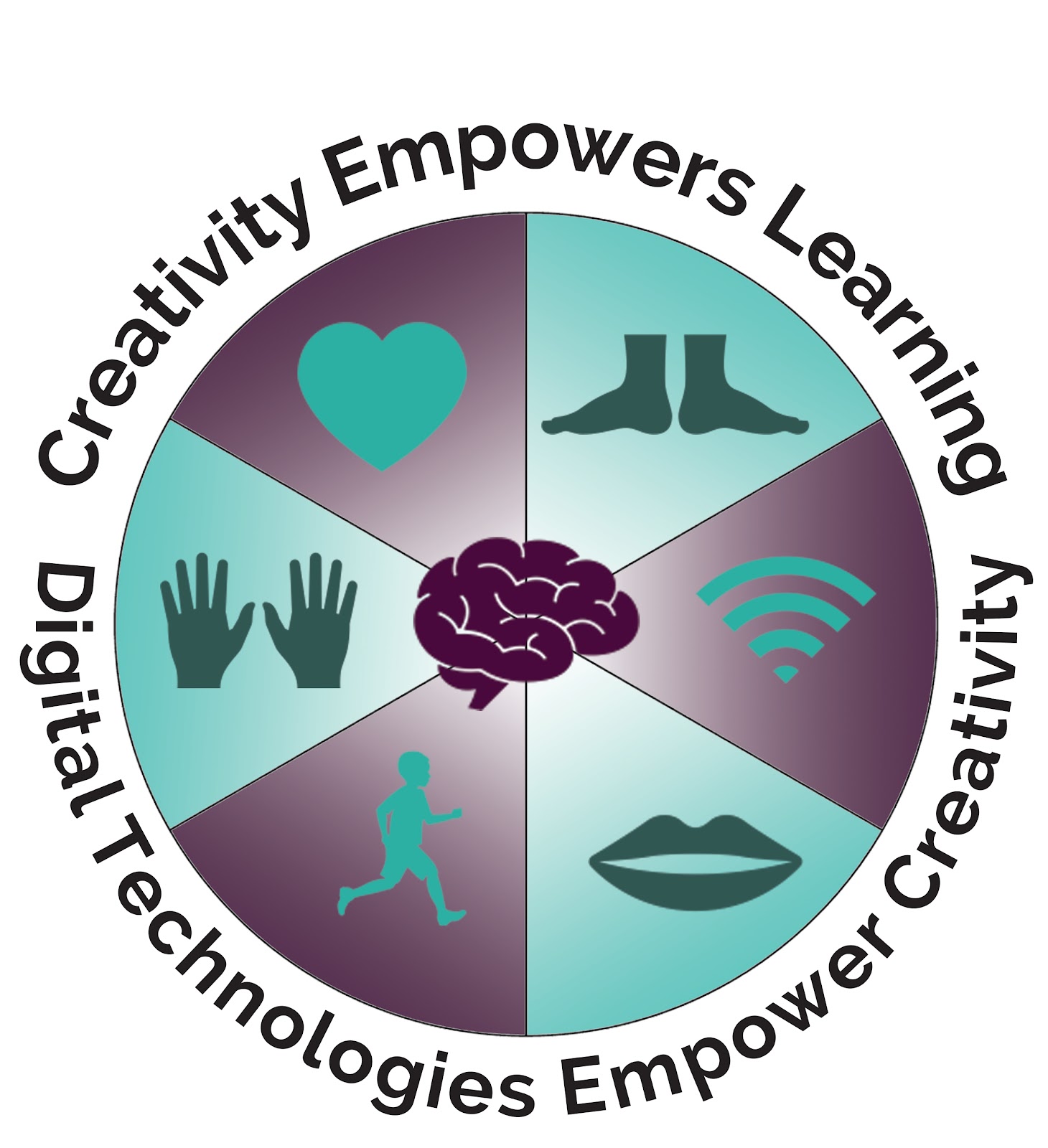
The image above reveals the different ways students are able to be creative: using vocals (singing, speaking etc), the whole body (dance, etc), hands, spiritual/wairua, feet, and with technology - which empowers the learning.
Creativity may be the process of learning, the hook into learning, and/or the end product. I can see wonderful opportunities as I continue my digital learning journey through the Digital Fluency Intensive and for creating and sharing student learning using 'Explain Everything' with New Entrants during the next two terms. My personal journey into a blended digital classroom begins!
"Creativity is now as important in education as literacy, and we need to treat it with the same status"