Showing posts with label STP2 Professional Learning. Show all posts
Showing posts with label STP2 Professional Learning. Show all posts
Tuesday, September 21, 2021
My Teaching Inquiry
What has gone well?
[Introduce/practise using algorithms in an everyday context to develop computational thinking.]
Most students think more carefully about solving a problem and can talk about ‘how’ they solved it.
Students were engaged throughout unplugged coding activities. All worked co-operatively in pairs and small groups.
Many students have improved their backward counting skills, 1 less/1more knowledge and strategies, left/right and forwards/backwards knowledge.
What has been a challenge?
Time restraints due to lock down.
Timetabling regular sessions.
JAM assessments revealed that a few students have rote-learned backwards counting from 10 but can’t count back from 20 using the ‘one less’ strategy.
Teacher involved supporting students in new learning and not taking photos for the class Blog.
What was an ‘aha’ moment with your students?
Students realising the need to be exact when completing unplugged coding activities i.e. understanding the problem to be solved, direction, careful counting, double-checking.
Where to next?
Continue using unplugged grids.
Introduce Bee bots.
Tuesday, August 17, 2021
Computational Thinking - Unplugged Early Years
Last week Donna Golightly from 'Using Technology Better' has developed a site using the theme of Fairy Tales to support computational thinking. I look forward to using the resources available through the following link. Fairy Tales
The site has links to five well known Fairy Tales. Each Tale includes:
links to curriculum areas
computational thinking concepts
activities
literacy and/or maths focusses
a digital technology focus
sequencing images
a grid mat
assessment and reflection ideas.
This resource gives direction and structure for planning computational thinking units and could be adapted for different themes and learning levels.
We have also ordered a class set of Bee-Bots to with some plastic grids.
Why should we integrate unplugged computational thinking activities into learning?
"Students are given challenges based on a few simple rules, and in the process of solving those challenges they uncover powerful ideas on their own. Not only is this a more memorable way to learn, but it empowers them to realise that these are ideas within their grasp. The activities are also very kinesthetic - the bigger the materials, the better." csunplugged
Today Te Kakano students and myself had the pleasure of Donna Golightly facilitating an unplugged lesson.
Activity 1
Donna began by choosing a classroom stool and 1 student. The student was a robot and had to be told what to do and where to go because a robot has to be programmed. It cannot think on its own. The students had to give the robot instructions to get to the stool and sit down. It took a few attempts to direct the robot correctly with the students learning about the importance of exact instructions. The vocabulary included the words 'turn, right, left, forwards, backwards, straight.'
They chose a blank starting square on the outside of the grid and then had turns at telling Donna where to go next. She recorded the instructions using arrows on the white board. The students got to name the creature i.e. a 'elesnail.'
Activity 3
The students repeated the above activity in pairs, recording their progress with arrows.
Activity 4
One student secretly chose 2 body parts and then plotted out the directions using arrows. the partner then followed the arrows.
The students remained engaged throughout and I look forward to reinforcing todays learning with similar lessons.
Managing Change to Achieve Improvement - a two day workshop facilitated by Brian Hinchco
Purpose:
To develop an alignment between the work of each school leadership team with that of the Across Kāhui Ako leaders, and the Kāhui Ako vision for Te Hiku.
The Kāhui Ako initiative covered
The role of DPs and APs as change managers within their kura including unpacking the barriers that come with this work
The vision for Te Kāhui Tai Kura o Hiku as well as its strategic implementation plan
Change theory and models of change
Implementing change in our schools to achieve improvement
Aligning the current Kāhui Workstreams; Wellbeing, Te Reo ono Tikinga Maori, and Spiral of Inquiry
Meeting the competing drivers of the Kāhui Ako, The Iwi, The Ministry and our own school needs
An opportunity to work professionally with others across the rohe with similar responsibilities and challenges as themselves.
“The curriculum encourages all students to reflect on their own learning processes and to learn how to learn.”
The New Zealand Curriculum
Pupils’ learning is more productive if it is reflective, intentional, and collaborative, practices which may not come naturally but can be taught and can lead to pupils taking responsibility for their own learning.
Black et al., 2006, page 126
It is important that teachers acknowledge, and set High Expectations for, abilities and talents of all students. These should reflect New Zealand's bi-cultural heritage and the it's increasing cultural diversity.
Today's workshop had me reflecting on how I personally set and maintain a culture of high expectations in my classroom.
Do I:
plan for goal setting and mixed ability groupings across the curriculum?
establish a positive culture of care?
promote student autonomy/agency?
To ensure a culture of high expectations I must:
avoid bias when setting goals for/with students
know my students really well through accurate monitoring and relationship
set high expectations for all students regardless of race
display/embed culturally responsive pedagogy i.e. acknowledge the Maori world view (te ao Maori) if there is a high percentage of Maori students
How do I see this working in the New Entrant classroom?
In my New Entrant classroom I want to ensure a positive learning culture therefore the classroom environment must firstly feel a safe place for all students. I want all the children who start off school life under my guidance to see themselves as great learners. Growth Mindset will be embedded into teaching/learning. Developing student autonomy or student agency starts with the knowledge of "I am a learner" and "I love learning." It also means developing the language about learning so there is a focus on oral language development which includes vocabulary development, talking about our learning, listening, noticing and understanding [comprehension]. Making learning models visible in the classroom has helped to develop student understanding about goal setting for e.g. 'What does good writing look like?' There are examples of student writing and visuals of what we need to do when writing. We visit the writing wall and students are learning to identify what they can currently do independently and what they need to do to improve [next steps]. We are at the beginning stage of learning to set goals.
My most valued take-home reminders from today's workshop:
The need to display unconditional warmth
The need to build self-esteem for some students
Teachers are role models. Teachers are central figures to some students.
Students reflect teacher behaviour [ being calm, polite, sensitive, responsibile for own behaviour]
Teachers need to know the family background of students
The language teachers use is very important
To seriously think about which students are most vulnerable and what actions I can take to help them develop a healthy self-esteem and become positive class members.
I need to focus on the positive for each student
I need to be aware of my non-verbal communications and what I am indicating by facial expressions and body language
Is my behaviour management with some students preventive or reactive?
The best single predictor of future reading achievement at school entry is phonological awareness.Gillon (2004); Pressley (2002); Elhri et al (2001); Goswami (2001); Blachman (2000)
Today 3 colleagues and myself participated in Phonics and Early Word workshops taken by Yolanda Soryl. As a New Entrant teacher I am noticing year-by year a decline in oral language skills [listening, speaking, understanding] of children starting school. Low level oral language skills impact on learning to read and write. As a junior syndicate we are interested in addressing this issue in as many ways as possible. Phonics has always been a foundation to literacy learning at our school however we need to change teaching practice to make learning more effective. Attending these sessions was the next step on our phonics learning journey.
Our Observations prior to attending
Students who are making slow progress in reading and writing:
have difficulty tuning in and noticing detail in what what they hear and see
have difficulty distinguishing between letter-sounds
communicate with gestures only or incomplete sentences
use incorrect grammar
have difficulty forming letter sounds which makes it hard for the listener to understand what is being said
have limited vocabulary which affects their understanding of what they are hearing and also makes reading for meaning difficult
make little or no connection between spoken ideas, reading and writing
All of the above points impact on a healthy self-esteem and growth mindset required for learning. Based on these observations my inquiry question is:
What strategies and resources can we use to increase/improve/develop the oral language skills, and raise achievement in reading and writing for our priority learners?
'Phonemic awareness is fundamental to early success in reading and writing … An understanding of phonics also underpins children's literacy learning. Children need to learn, through deliberate, focused instruction, which letters represent which sounds.' — Effective Literacy Practice in Years 1–4, (2003, p.32), Ministry of Education, Wellington.
What did I learn that increased my understanding of phonics and the teaching of phonics?
Phonics Workshop Reading requires:
Knowing letter sounds
Knowing how to blendsounds together
Graphic knowledgeand memory [e.g. for high frequency words]
Comprehension
Fluency
That when faced with a new word, a child can use graphic knowledge (word chunks i.e. ing; gr-a-ph etc) and phonics (letter sounds).
Writing requires:
Knowing letter sounds
Knowing how to blendsounds together
Graphic knowledgeand memory (e.g. for high frequency words
Segmentation
Re-reading
Terminology Phoneme: The smallest sound you can hear in a word Grapheme: The written form of a word. A grapheme can have 1 letter, 2 letters [digraph e.g. th], or 3 letters [trigraph e.g. thr]. The number of graphemes in a word will match the number of phonemes.
Stages for teaching phonics
Key points for teachers:
Clap rhythms for children to repeat, so they can hear and hold structures (e.g. first line of Humpty Dumpty). This is critical for holding a sentence in their heads during writing.
Music and movement is fundamental for learning. Bring it in as much as possible, e.g. sing instructions and have the children sing them back. Singing lights up the left side of the brain, the same area required for reading. Therefore it is a great warm up
Schedule daily poetry & story reading to strengthen children’s phonological listening and enjoyment of reading, and train the brain for fluency by using triggers e.g. ‘on your marks’.
Teach the five rhyming families: cat, pet, fin, dog, bug
Be explicit about knowledge transfer i.e. tell children ‘you can use this in your reading. When you come to a word you don’t know, you can use this letter…’
‘You can use this when you are trying to spell a new word.’
Have children re-read their writing after every word and sentence
At Stage 2 teach a new phoneme everyday.
Separate handwriting and phonics lessons - phonics lesson first
What did I learn that I could use with my learners?
I intend to make an immediate change to my phonics programme by teaching a different phoneme four days a week. In term 3 I will follow Yolanda's programme more explicitly. I will also use/teach more nursery rhymes and rhyming games, and intentionally focus on listening for sounds in our environment.
Early Words Workshop
This was the second workshop of the day. The Early Words programme is set out clearly in Yolanda Soryl's handbook which I purchased for the school. The programme helps lower level students to achieve success in word recognition and graphic knowledge of high frequency words. The programme takes 5 minutes per child, per day. It involves simple home learning activities related to that day's learning. My intention is to train two teacher aides to use this programme daily with our struggling readers.
The structure of each 5 minute lesson:
Probe test – gives the score from the word learnt yesterday. Students are given the words and then the teacher tests the errors and the time taken to complete and then scores them accordingly.
Teacher decision – after testing with the probe the teacher decides whether the student goes up a word or remains at the same for another day.
Word cards – this is the time spent teaching the student the word using a range or games and having the word in isolation (out of text).
Worksheet – this is either a reading or writing worksheet where the word is transferred into text.
Probe test – as above, gives the score from the word learnt.
Revision – an activity not needing adult supervision usually completed for home learning.
As part of her commitment to providing clear and valuable information to teachers and parents, Yolanda has produced a collection of lesson videos. These cover varying techniques and stages of Phonics, Early Words and Developing Phonological Awareness. Free resource downloadsfrom Yolanda Soryl
Professor Christine Rubie-Davies from the University of Auckland presented to the Manaiakalani Te Hiku cluster on 'Creating high expectation schools.' Teaching practices were outlined, that could improve the self-esteem of students. A main focus was finding alternatives to ability groupings within classroom programmes. Student self-belief is affected by teacher expectations therefore what a teacher values and how a teacher interacts through non-verbal and verbal signals sends messages to students about their abilities.
Key reflections for teachers
How do you form your expectations?
What influences your expectations?
What forms of evidence influence your expectations?
What have I learned that increased my understanding of high expectation learning?
1. Teacher expectations may influence learning support and emotional support.
Examples:
differential learning support
differential emotional support
verbal behaviours
non-verbal behaviours
the leakage heirachy
2. Expectations may influence stereotyping and bias. The consequences can be:
reduced opportunity to learn
warm and supportive interactions
increased learning support
positive emotional support
challenging learning activities
expectations of success
3. Many factors contribute to the way teachers behave towards their students and the expectations they have for individual student achievement.
How will this pedagogy EMPOWER me professionally with my teaching practice?
I want to ensure that ALL of my students feel empowered and have a positive self-belief that they are successful learners. I want to ensure I know what is going on for my learners and provide them with the opportunities to overcome any barriers to learning that are identified.
Key messages about grouping
Ability grouping may have limited or detrimental effect on student learning.
Ability grouping may have limited or detrimental effect on student achievement.
Planning for change
How will you set up a high expectation classroom?
Demonstrate through my interactions with students that my expectations are high for all of them. My words, gestures, body language and flexible grouping/activities will reflect that my expectations are high for all students.
What differences will you make to the way in which your syndicate/department
sets up instruction for reading/writing/maths?
I will intentionally have more mixed and flexible grouping across all curriculum areas to encourage self-belief, student agency and collaboration.
How will you ensure maximum opportunity to learn for all students in your
syndicate/department?
Provide the opportunities mentioned above and the necessary support for students to be able to do what is required.
What learning experiences will you include so all children are challenged?
Provide a variety of learning tasks that are scaffolded with different degrees of challenge [independent, some support required, step-by-step support]. Students will have choice about which learning tasks they complete.
In 2019 the Junior classes at school are introducing more ‘learning through play’ into class programmes. We need to adjust and alter our programme in order to meet the diverse needs of our students. Teachers from the New Entrant and Year 1/2 classes have been reading about the positive effects of play-based learning environments.Over the past five years we have noticed a steady decline in the range of achievement levels in oral language, reading, writing and maths.
Many children entering school at five years of age, are simply not ready to begin formal lessons as we have had in the past.
What did I learn that increased my understanding of Learning Through Play pedagogy?
After attending two days of professional development in Kerikeri during the holidays, we see more clearly how this fits into the NZ curriculum and benefits the children in a variety of ways: - helps to build problem solvers - encourages curiosity and concentration - develops language and memory skills - improves academic learning Play is an ideal way for children to develop social, critical thinking and problem solving skills and still retain literacy and numeracy as the main focus in the junior school.
A significant deterioration in the gross and fine motor skills of many children could be attributed to a lack of physical activity and outside play. Some children are unable to sit upright on the mat or at tables for long due to poor core strength. Some have very little upper body strength and cannot hang or climb without assistance. The lack of fine motor control means that children find it difficult to grip and control pencil, crayon and brush movements. Writing and handwriting is complex enough, without struggling to hold and manipulate the pencil. I learned about the characteristics of play as clarified by Sarah Aiono, and now see play with a new perspective.
The Characteristics of Play Primarily, play is:
1. self-chosen and self-directed;
2. process rather than product driven;
3. contains structures or rules established by the players themselves;
4. imaginative, non-literal and removed from reality;
5. occurs between those who are active, alert and non-stressed.
(Gray, 2013; Brewer, 2007)
Many children’s creativity and imagination is stifled due to limited opportunities to explore, discover, create and discuss. These are essential skills that the children will need to learn through inquiry, as they grow older and move on through the year levels.
How has the Learning Through Play pedagogy EMPOWERED me professionally with my teaching practice?
We feel that due to the former National Standards constraints and timeline constrictions, we have been unable to cater for these escalating needs by giving children time to learn through play. Because some children are not ready for more formal learning activities/lessons, they show signs of anxiety which in turn causes additional barriers to learning for them. Understanding that from three years to seven years children are typically within the pre-operational cognitive stage means our school children in Years 1 to 3 (Level 1) are typically operating within this stage of development and therefore need learning experiences that cater for this. This perspective has inspired me to make changes in my teaching practice. I feel supported in the knowledge that the changes are suited to the developmental stage of the students. The following slides from the 'Learning Through Play: The Nitty Gritty' workshop give an idea of the day's content. I highly recommend attending both the workshops if you are thinking about making changes to your learning programme in Years 1-3 particularly. https://drive.google.com/open?id=1hRnXACinlujrfsWdqDtFlbYryy4eA4N2
Recommended Reading to support a Play Based Teaching and Learning Journey:[Sarah Aiono]
Free to Learn by Peter Gray
The Best Schools by Thomas Armstrong
Creative Schools by Sir Ken Robinson & Lou Aronica
Online Video Material (You Tube): Kathy Hirsch-Pasek Scrap Store Playpod
Peter Gray 'The Decline of Play'
Sir Ken Robinson (TED) 'Do schools kill Creativity'
What did I learn that could be used with my learners?
I understand that we are at the beginning of our Learning Through Play journey which, we are advised, can take five years.
Our plan for the first year is to provide resources which will cater to the schema or urges of the students
- increase the time allowed for Learning Through Play. - provide resources (inside and out) to enable LTP. - utilise our beautiful school grounds to develop more outside play
areas
Sandpits - designed by children and teachers
Tree climbing
Hill rolling/sliding
Digging/roading/science/geology
Hut making in the bamboo and gardens/habitats
Water play/moving water/volume
Carpentry/measurement
Potions table/science
Creative play areas such as theatre/shop/vet clinic
Art creations
Covered outdoor play area within sight of junior classrooms
Outdoor storage (wheelie bins or shed) for loose parts used in play
e.g. pipes/reels/building materials
Literacy and numeracy will still be covered daily. Reading, writing and mathematics groups will be withdrawn and taught during LTP time. The timetable will need to be flexible to allow this.
Children will also still participate in all school-wide and timetabled events. Children will continue to be assessed and reported on as per usual.
Since attending the workshops we reported to the school Board of Trustees on our Professional Learning Development, and asked consent to begin by designing the sandpits with student input. We are grateful to our B.o.T. who totally support us in making changes to the class programmes and environmental alterations, and will provide the resourcing to make it all possible.
What did I learn that could improve my confidence, capability or workflow as a professional?
Thank you Kerry, Dorothy and Dave for having this session and for recording it. I have used sheets before for collecting data but learned today how to freeze rows and columns, use the function key to analyze, and, to make, share and put charts onto a separate sheet. I will definitely use what I learned today to analyze and sort student achievement data. Creating charts from student data will visually support reports made to the B.o.T on student achievement and progress.
What did I learn that could be used with my learners?
I would like to use forms to gather feedback from whanau instead of paper forms. It will make data analyzing a lot easier and the whole process more manageable.
What did I learn that could improve my confidence, capability or workflow in my personal life?
Using forms to collect data and then simply turning it into a sheet will make data collecting and analyzing a much quicker and more enjoyable process especially on a school wide basis.
This timeline activity that I completed in our Staff Meeting facilitated by Donna Yates from Manaiakalani, presents a clear overview of how social media and digital technologies have dramatically increased the opportunity to be connected worldwide. I think that advancements and opportunities will increase at fast rates with continuing improvements to make access easier.
What did I learn that increased my understanding of Manaiakalani kaupapa and pedagogy?
Empowerment gives people control or agency over their own lives.
As teachers we should first identify what disempowers the students and their whanau in our communities. 50% of those living in the Far North represent the 5th most deprived people in NZ. As educators we must consider the impact of poverty on our students and what we can do to change this.
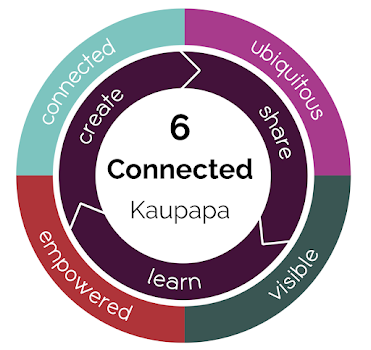
Manaiakalani pedagogy aligns with the NZ Curriculum in the firm belief that students must be given opportunities to develop 'capabilities for growing, working and participating in their communities.' Students need to feel comfortable in the digital world because this the future. They can not be empowered unless they have agency/choice in their learning and are able to create their own digital footprint in a digital world - VISIBLITY. They will not be empowered until they can learn globally, at anytime, anywhere - UBIQUITY. Student learning will not be visible or ubiquitous unless they are CONNECTED and are able to share and collaborate.
Manaiakalani pedagogy aims to empower students, their whanau and teachers through digital technology capability. Digital technology should NOT be understood as just a tool but instead as the means to empower our lives. Class sites and Blogs therefore need to be visible and accessible to whanau which will support families to be more connected to schools and to discuss and understand the learning of their children.
How has the Manaiakalani kaupapa EMPOWERED you professionally with your teaching practice?
Today in the beautiful setting at the Waitangi Museum we had the opportunity to develop our understanding of Hangarau Matihiko, the new Digital Technologies Curriculum which has two strands: 1.Computational Thinking for Digital Technologies 2. Designing and Developing Digital Outcomes
Monika and Kerry from the Raranga Matihiko programme gave us the wonderful opportunity to inquire into computational thinking and design by experimenting with a variety of amazing resources.
I had fun discovering with Esther Dickenson as we created the following video using the 'Green Screen', and adding photos to the background. Our 'bloopers' were not arranging/inserting objects in the right order and that is why the whare, which should have been in the foreground, is imposed on the photo of trees and sky in the background. The outcome is still pretty cool. What a great activity for using and developing the imagination and creativity. I would love to set up a 'Green Screen' booth or corner in the play room next year.
How has the Manaiakalani kaupapa EMPOWERED you with new skills to use with your learners?
Computational Thinking is a task broken down into little parts i.e. coding. Decomposition skills can be taught/practised without devices. This is coding 'unplugged' which I loved the idea of and can see this working really well in the junior classroom to develop computational skills, thinking and the key directional vocabulary in a collaborative and fun way. The coding app/programme 'SCRATCH' developed by Mitchel Resnick provides printable coding tiles to be used in this way. I will certainly take advantage of this. I've also ordered his book 'Lifelong Kindergarten - Cultivating Creativity' to help give some inspiration as I work towards establishing play-based learning at our school. Blending the 'Manaiakalani' and 'Learning through Play' pedagogies will be my focus.
How has the Manaiakalani kaupapa EMPOWERED you personally?
My learning today has given me a clearer perspective of the Manaiakalani kaupapa and the necessity of preparing our students for the future. This pedagogy links to The Digital Technologies Curriculum perfectly. Both have their roots in creativity and diversity, teaching and using the skills that will be required for productivity and input to better our communities and personal wellbeing and accomplishments. Computational thinking can be applied to any activity [waiata ringa ringa; poi, rakau, tukutuku panels]. It is about applying rules, patterning and relationships, and can be intergrated into any classroom focus to make the learning authentic. Good pedagogy dictates that we do this anyway. It is the scaffolding that gives structure and embeds the learning. .
What did I learn that increased my understanding of Manaiakalani kaupapa and pedagogy?
Today's focus was 'Being Connected.' Being connected empowers students. It takes their learning beyond themselves Being connected online means 'being visible' and involves being connected to whanau, to other schools, the local community, the nation and the wider world.
Manaikalani currently has 22,000 learners in it's network who are connected by a shared language and pedagogy. The programme design focuses on a different aspect of the Manaiakalani pedagogy each term.
Term 1: Learn - setting up systems Term 2: Create Term 3: Share Term 4: Learn, Create, Share
A school's kaupapa, the year level of students and the teacher may influence this guideline but across the network each school will focus on the same design aspect
What did I learn that will increase my confidence, capability or work flow as a professional?
Being connected empowers teachers. Clarelle Carruthers encouraged us to take opportunities to learn from others i.e. 'Toolbox' sessions where we can discuss ideas, share and learn from each other. This can be done by developing a cluster website, a Twitter feed [students don't twitter], link to Twitter feeds from other Manaiakalani clusters and the Tuhi Mai Tuhi Atu Blog which connects to other classes.
I also came away from today's session feeling a lot more confident that I will be able to have visible, connected learning in my own classroom. I changed and earlier attempt at a class site applying the tips from Clarelle and Kerry about colour schemes and targeting the main users [my students]. I am so much happier with the look now. We also gave feedback via a Goggle Form to others on their website designs. I gathered tips from all of the sites and was so impressed with what my colleagues have designed and implemented.
What did I learn that I could use with my learners?
I have started designing Google Slides and projects using 'Explain Everything' for 'Letter Sounds' and 'Handwriting.' I intend to get this up and running and iron out any wrinkles before attempting another curriculum area. So the letter Zz project looks like this. I have not got everything up and connected yet but am happy that I am out of the starter blocks. The Zebra will connect to the letter z in the Letter Land programme which we have not purchased for the iPads yet. The E button will take students to letter-sound and handwriting activities. In EE I used the recording tool to say the W.A.L.T, the letter-sound, and word associated with pictures. This is a great tool to use for New Entrants that can't read. It was very easy to use.
What did I learn that could improve my confidence, capability and workflow in my personal life?
I know that I have the responsibility to introduce the use of Explain Everything to the other Junior Class teachers at my school. I need to be confident in the use of it myself. I've started the journey and have a plan. I have designed a site that will be used by both classes in our syndicate. I am confident that step-by-step, with time, experimenting, calling on help from the experts and having a bank of appropriate learning resources, digital learning will give me more time in my personal life.